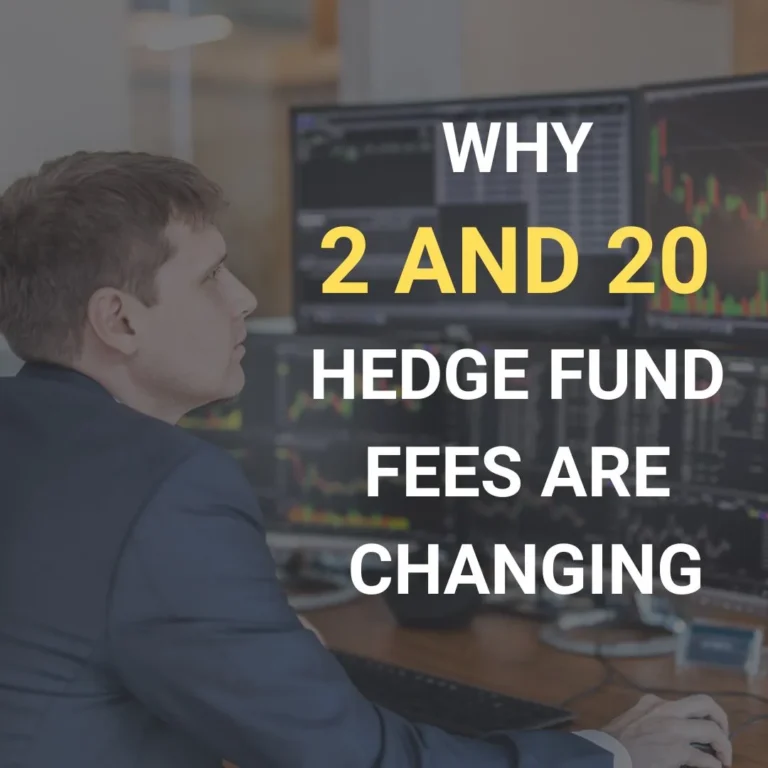
Inside the hedge fund fee revolution: performance demands, investor pressure, and the rise of smarter structures.
The “2 and 20” fee structure — 2% management fee and 20% performance fee — once defined the hedge fund industry.
It funded sophisticated strategies, attracted top talent, and made hedge fund managers some of the wealthiest figures in finance.
Today, that model is under siege.
Faced with underperformance, rising competition from passive investing, and fee-conscious clients, hedge funds are rethinking how they charge investors.
New models are emerging that reward real performance — not just asset growth.
The era of “2 and 20 by default” is ending.
Here’s why, how, and what it means for the future of hedge funds.
How 2 and 20 Became the Gold Standard
The roots of the 2 and 20 structure trace back to 1949, when Alfred Winslow Jones founded A.W. Jones & Co., the first hedge fund.
Inspired by seafaring merchants who kept a fifth of profits from successful voyages, Jones adapted the idea to finance.
The formula proved irresistible:
A 2% management fee covered operating costs.
A 20% performance fee aligned incentives between managers and investors.
For decades, the model worked beautifully.
In the 1980s and 1990s, hedge funds consistently generated uncorrelated, alpha-rich returns. Investors eagerly paid for access.
But times have changed.

The Cracks: Mediocre Returns, Rising Competition, and Fee Fatigue
Since the Global Financial Crisis of 2008–2009, cracks in the 2 and 20 model have widened:
Performance Disappointment: Hedge funds, as a group, have consistently underperformed broad equity benchmarks like the S&P 500.
Passive Pressure: Low-cost ETFs and index funds — charging as little as 0.09% annually — have become formidable competitors.
Increased Scrutiny: Investors are no longer willing to pay high fees for mediocre beta exposure.
Transparency Demands: Clients now expect clear alignment between fees and net-of-fee results.
In short, many investors felt they were paying “alpha prices for beta returns” — and they started asking hard questions.
Investor Demands: From Fee Tolerance to Fee Activism
The shift in investor attitudes has been dramatic:
| Investor Demand | What It Means |
|---|---|
| Hurdle Rates | Managers must beat a cash benchmark (e.g., cash + 5%) before charging performance fees. |
| High-Water Marks | No performance fee unless prior losses are recovered. |
| Lower Management Fees | Management fees of 1.5% — or even below 1% — are becoming common. |
| Pay-for-Performance Structures | Innovative models like “1 or 30” reward only true alpha. |
| Greater Manager Co-Investment | Managers are expected to invest meaningful personal capital (“skin in the game”). |
In 2022, only 15% of investors favored hurdle rates.
By 2023, that figure skyrocketed to 66%, according to BNP Paribas.
The message is clear: investors want performance, not promises.
Case Study: Aperture Investors and the New Fee Frontier
Some hedge funds aren’t waiting for client pressure — they’re proactively reinventing the model.
Aperture Investors, a $3.8 billion hedge fund founded by Peter Kraus, operates under a radically different system:
Low base fee, comparable to an ETF.
30% performance fee on alpha, but only if the fund beats a clearly defined benchmark.
Rigorous index matching to ensure fairness and relevance.
Strict portfolio manager compensation tied to fund performance.
Kraus explains the rationale simply:
“Asset growth is the enemy of performance.”
In traditional models, managers are incentivized to gather more assets — even if it degrades returns.
At Aperture, success is judged purely by outperformance.
Interested in Learning About Other Hedge Fund Strategies?
The Rise of the “1 or 30” Fee Model
One of the most important innovations reshaping the industry is the 1 or 30 model, pioneered by the Teacher Retirement System of Texas (TRS) and consulting firm Albourne Partners.
How 1 or 30 Works:
Investors pay either:
1% management fee (if performance is modest), or
30% of alpha (only if substantial outperformance is delivered).
Never both.
This model balances two critical needs:
It funds the operational infrastructure of hedge funds.
It rewards true skill, not asset accumulation.
Today, around two-thirds of Texas Teachers’ $20 billion hedge fund portfolio uses the 1 or 30 model.
More than 60 major institutional investors have now joined the movement pushing for hurdle rates and smarter structures.
| Feature | 2 and 20 Model | 1 or 30 Model |
|---|---|---|
| Management Fee | 2% annually, charged regardless of performance | 1% annually, unless performance exceeds hurdle |
| Performance Fee | 20% of profits over a hurdle (if applicable) | 30% of alpha only if performance exceeds hurdle |
| Alignment of Interests | Weaker alignment; managers incentivized to grow assets | Stronger alignment; managers rewarded only for alpha |
| Investor Protection | Performance fees can be earned despite low relative returns | No performance fee unless true excess return generated |
| Focus | Asset growth and fundraising | Consistent outperformance of benchmark |
| Adoption Trend | Declining among new mandates | Rapidly gaining traction among institutional investors |

What’s Driving the Fee Revolution?
Several forces are converging:
| Force | Effect |
|---|---|
| Underperformance | Easier to challenge premium fees. |
| High Cash Rates | Investors want a true excess return over cash, not absolute returns. |
| ETF Competition | 9bps S&P 500 ETFs are the new baseline. Hedge funds must justify their costs. |
| Regulatory Focus | Greater scrutiny on fee disclosure and fairness. |
| Technological Innovation | Funds using AI and automation must deliver real alpha, not just cost savings. |
Managers who can’t articulate their value proposition — and back it up — will struggle to survive.
Winners and Losers in the New Era
| Winners | Losers |
|---|---|
| Elite performers (e.g., DE Shaw, Renaissance Technologies) | Mediocre funds offering beta at alpha prices |
| Niche, capacity-constrained strategies | Large, bloated multi-strategy funds without differentiation |
| Managers offering true alignment and transparency | Managers clinging to outdated, opaque fee structures |
In a world of smarter, fee-sensitive investors, only true alpha will justify premium pricing.
Final Thoughts – Evolve or Be Left Behind
The 2 and 20 fee structure isn’t dead — but it’s no longer the industry default.
It must now be earned, not assumed.
Hedge funds that want to succeed must:
- Deliver sustainable, differentiated alpha
Embrace fairer, performance-linked fee models
Align their interests tightly with those of their investors
Communicate with radical transparency
Those that cling to the old ways will find themselves sidelined.
The future belongs to the funds that understand this new reality:
In the age of fee scrutiny, you don’t get paid for trying — you get paid for winning.
HEDGE FUND STRATEGIES
EQUITY-BASED STRATEGIES



EVENT DRIVEN STRATEGIES




RELATIVE VALUE STRATEGIES



OPPORTUNISTIC STRATEGIES


OPPORTUNISTIC STRATEGIES