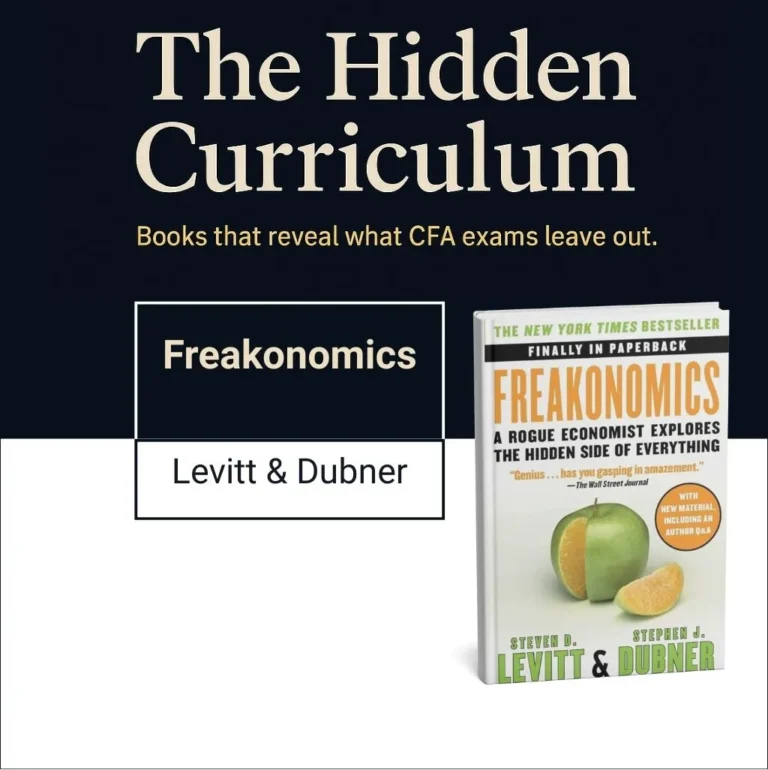
Freakonomics by Steven D. Levitt and Stephen J. Dubner
Hidden Lesson: If you don’t challenge assumptions and ask unconventional questions, you’ll miss the truth hiding in plain sight—and possibly make costly, avoidable mistakes.
What the CFA Curriculum Teaches You
The CFA Program is built on structure, consistency, and methodical inquiry. It trains you to follow process, analyze risk, and apply established models to investment decisions. It teaches integrity, professionalism, and the critical importance of accurate information.
But it doesn’t teach you to question the question. It rarely invites you to turn the problem inside out or ask what might be wrong with the way you’re framing it. The CFA curriculum gives you the tools—but not always the skepticism—to challenge conventional wisdom.
What Freakonomics Reveals Instead
Levitt and Dubner’s core message is as subversive as it is liberating: the world doesn’t work the way you think it does. Real estate agents don’t always act in your best interest. Drug dealers live with their moms. Incentives drive behavior far more than values. And when you look at the data closely—really closely—unexpected truths emerge.
Their style is playful, but the implications are serious: don’t trust narratives without proof. Don’t accept the surface explanation. And never underestimate the power of hidden incentives. Whether analyzing school choice, crime rates, or cheating teachers, Freakonomics turns traditional logic on its head and rewards those willing to dig deeper.

Real-World Trigger
You’re on the job as a junior analyst. The head of the desk just told you, “This stock is undervalued—it’s a strong buy.” You run a DCF. The numbers look tight, but plausible. No one else seems to be questioning it.
Here’s your moment: do you ask the uncomfortable question? Do you check whether management is timing earnings? Do you look for incentives baked into executive compensation that might contradict their public messaging?
Or do you nod and move on, afraid to look like a troublemaker?
Freakonomics would tell you to ask the damn question. Because in finance, as in life, the real risk is often hidden in the assumptions no one dares to test.
Why This Book Still Matters
This book isn’t about finance—but it’s essential for financial thinking. It shows you how to develop a habit of mind that’s invaluable in the investment world: intellectual curiosity + data rigor + skepticism of the obvious.
In a profession where everyone is modeling cash flows and comparing ratios, the edge often goes to the one who sees what others ignore. Freakonomics is a masterclass in spotting what others miss—because you’re asking a better question.
Reflection for CFA Candidates
Are you training to be a formula user or a truth seeker?
How often do you question the assumptions baked into the models and systems you use?
Are you alert to the hidden incentives influencing the people you work with—and the ones influencing you?
Final Thought
Before your next mock exam, consider this: the biggest errors in finance aren’t numerical—they’re conceptual. Freakonomics trains you to think differently. And sometimes, that’s more valuable than getting Question 47 right.