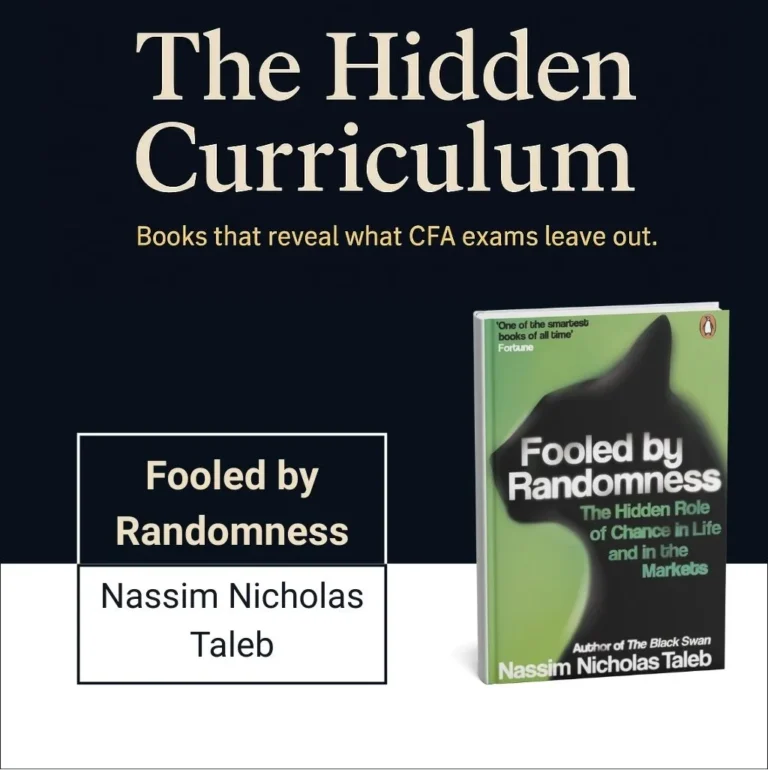
Fooled by Randomness by Nassim Nicholas Taleb
Hidden Lesson: You are mistaking luck for skill—and the market will punish you for that arrogance harder than any exam ever could.
What the CFA Curriculum Teaches You
The CFA Program arms you with the tools to measure risk, price assets, and interpret performance. It’s meticulous, structured, and obsessed with rational frameworks. You’ll learn all about standard deviation, VAR, Sharpe ratios, and alpha. You’ll be trained to analyze outcomes and build narratives around performance.
But here’s the uncomfortable truth the curriculum skirts around: most of what passes for skill in finance is just variance in disguise.
The CFA curriculum is built on models. Elegant models. Assumptions are clearly stated. Data is treated as clean. Returns are dissected with clinical precision. It’s a beautiful fiction—and dangerously incomplete.

What Fooled by Randomness Reveals Instead
Taleb slaps you across the face with reality: markets are messy, narratives are flawed, and humans—especially the ones in suits—are spectacularly bad at separating luck from causality.
You think someone’s a genius because they made money in a bull market? Taleb would laugh. He calls that survivorship bias. And he’s seen it ruin careers, blow up funds, and inflate egos until reality sets in—usually in a single afternoon.
This book doesn’t just challenge your thinking. It attacks your identity. It forces you to ask: Am I good? Or was I just lucky?
That’s not the kind of question the CFA curriculum prepares you to confront. But it’s the one every serious finance professional must answer—honestly, and often.
Real-World Trigger
Picture this: You’ve passed Level II, landed your first role, and your picks are outperforming. Your confidence grows. Colleagues nod when you speak. You start believing your own legend.
Then a regime shift hits the market. Your trades tank. Clients call. Your boss suddenly wants to “talk.” You realize your process wasn’t robust—it was just riding a wave you didn’t even see.
You didn’t fail because you lacked knowledge. You failed because you mistook noise for signal—and now the randomness you ignored has come to collect.
This isn’t hypothetical. This is how careers in finance actually implode.
Why This Book Still Matters
Because finance doesn’t reward the smartest. It rewards the most survivable.
You can master ethics, nail the L3 essay, and memorize the Black-Scholes formula—but if you don’t internalize the role of randomness in markets and life, you’re building your career on sand.
Fooled by Randomness is a brutal but necessary reprogramming of your worldview. It teaches humility. It teaches skepticism. And most importantly, it teaches you to respect the game you’re playing.
Because the market has one rule above all: Don’t get cocky.
Reflection for CFA Candidates
- Are you mentally prepared for success that’s unearned—and failure that’s undeserved?
- What part of your CFA preparation is grounded in process, and what part is just habit or hope?
- How would your career strategy change if you fully accepted how random success can be?
Final Thought
CFA candidates love to believe that passing all three levels means they’ve “earned it.” Taleb would tell you: maybe—but don’t get fooled.
Before you read another formula or mark another mock, read Fooled by Randomness. It might just save your career from the most dangerous bias of all: thinking you’re in control.