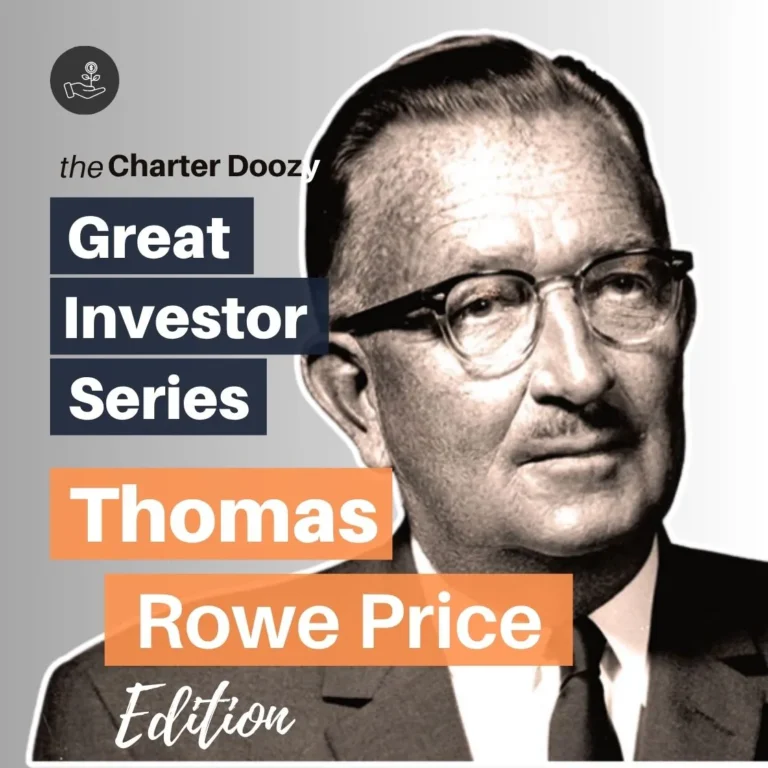
⭐ Thomas Rowe Price Jr. – Quick Facts
The Quiet Engineer Who Revolutionized Wall Street
In the depths of the Great Depression, when Wall Street lay in ruins and trust in stocks had evaporated, a reserved young man named Thomas Rowe Price Jr. sat at his Baltimore desk, mulling over an idea radical for its time: that the greatest fortunes would be made not in cheap “cigar butts,” but in buying stakes in companies with vibrant growth ahead of them—even if they looked expensive today.
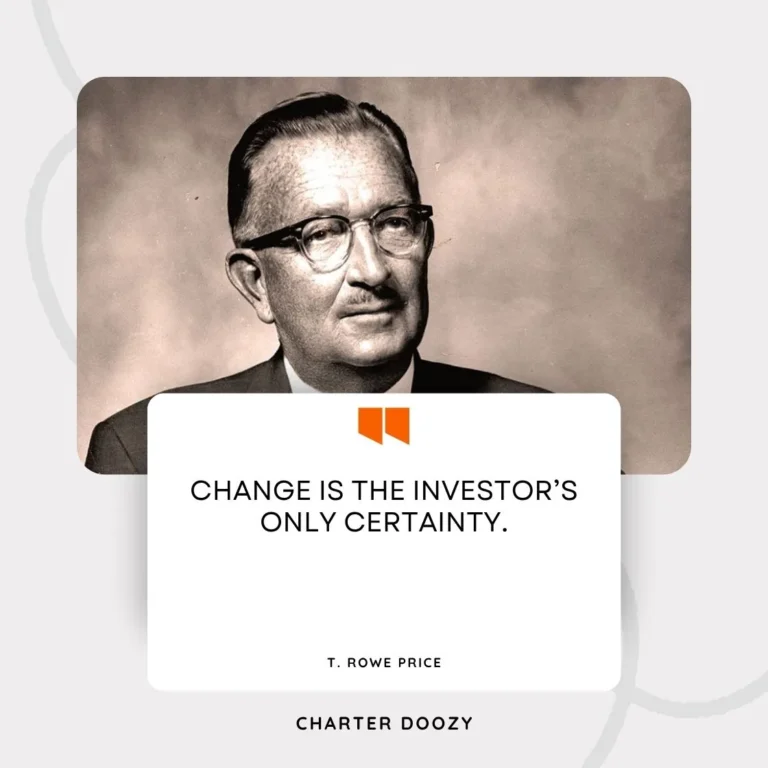
He once summed it up succinctly:
“Change is the investor’s only certainty.”
This quiet truth, uttered by the man later dubbed the Father of Growth Investing, would reverberate through financial markets for decades, eventually transforming how generations of professionals—and CFA candidates—think about valuation, compounding, and the long-term nature of business progress.
Rowe Price didn’t merely invest in stocks; he invested in the future. And in so doing, he helped shape the very fabric of modern portfolio management.
Want to think like the world’s best investors?
Dive into the mindsets, philosophies, and powerful quotes from legends like Soros, Fisher, Dalio, and more. Learn timeless strategies that turn insight into wealth – and transform how you see the markets.
Who Was T. Rowe Price?
Rowe Price Jr. was born in 1898 in Glyndon, Maryland, USA, and graduated from Swarthmore College in 1919 with a chemistry degree. His analytical mind and meticulous habits would have served him well in laboratories, but he instead drifted into finance. After working at brokerage firm Mackubin, Goodrich & Co., he launched his own investment advisory firm in 1937—T. Rowe Price & Associates—marking the start of an illustrious career that would span nearly half a century.
Price’s investing style was growth-oriented at a time when value investing, epitomized by Benjamin Graham, dominated Wall Street. While Graham’s disciples scoured markets for cheap stocks trading below liquidation value, Price looked beyond the balance sheet toward future earnings, management quality, and industry trends. He was, in many respects, the original growth investor.
His nickname—“the Father of Growth Investing”—is well deserved. He built not only one of America’s most successful investment management companies but also a set of principles that remain deeply woven into the CFA curriculum and modern asset management practices.
The Core Philosophy: Growth Over Value
A Vision Beyond the Numbers
At the heart of Price’s philosophy lay a deceptively simple proposition: companies with strong growth prospects are often worth paying up for, even if their current valuations appear high by traditional metrics.
In his own words:
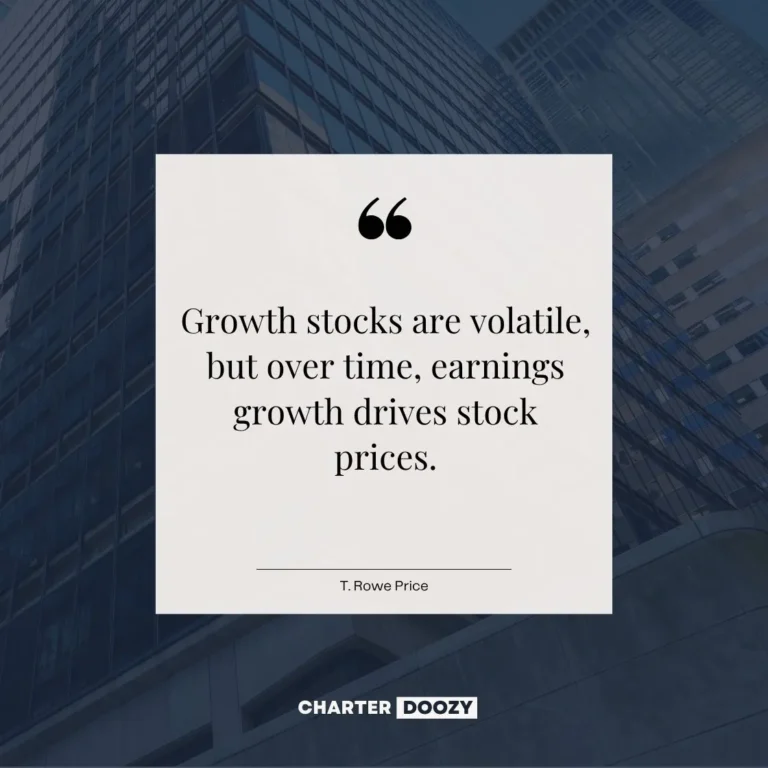
“If the earnings of a company are growing at a rapid rate, and if it seems likely that this rate of growth will continue for many years, then it is logical to expect that the price of the stock will advance correspondingly.”
Where Graham and Dodd demanded a “margin of safety” in the form of low price-to-book or price-to-earnings ratios, Price argued the real margin of safety lay in a company’s ability to grow earnings and cash flows over time. His analytical framework was holistic, blending quantitative analysis with qualitative insights into management, competitive dynamics, and secular trends.
The Four Pillars of Price’s Process
Though he never formalized a formula in the way that Graham codified value investing, Price’s approach can be summarized into four key pillars:
- Secular Growth Trends: Price sought industries poised for long-term expansion—think synthetic fibers in the 1950s, technology in later decades. He believed identifying macro trends gave investors an edge in selecting tomorrow’s winners.
- Superior Management: He placed great emphasis on capable, honest, and visionary leadership. This focus on management quality resonates strongly with the CFA curriculum’s emphasis on corporate governance.
- Financial Strength: Growth was essential, but so was a sound balance sheet. Price avoided firms whose expansion was funded with excessive debt.
- Price Discipline: Although willing to pay for quality, Price was careful to avoid euphoria. He aimed to buy growth stocks at reasonable valuations relative to their long-term prospects.
In modern terms, Price was an early practitioner of “GARP” (Growth At a Reasonable Price)—a term many CFA candidates will recognize from Equity Valuation readings.
Stories from a Growth Pioneer
Nylon and the Power of Secular Trends
One of Price’s most famous calls was his early bet on DuPont in the 1930s and 1940s. While much of the market was still recovering from the crash, Price saw enormous potential in DuPont’s synthetic fiber business—specifically nylon.
Nylon represented more than a new product; it symbolized technological innovation and widespread industrial applications. Price correctly anticipated that consumer demand for products like women’s stockings and industrial fibers would explode. DuPont became one of the era’s great growth stories, with earnings and share prices rising significantly over the subsequent decades.
This example dovetails perfectly with the CFA Level I and II focus on understanding industry analysis and the importance of secular trends in equity valuation models. Identifying future demand drivers remains as relevant today as it was in Price’s era.
The Birth of the Growth Stock Fund
In 1950, Price launched the T. Rowe Price Growth Stock Fund—the first mutual fund dedicated explicitly to growth investing. At the time, the idea was borderline heretical; mutual funds mostly held conservative “blue chip” stocks and bonds.
The Growth Stock Fund delivered robust returns over the decades, establishing Price as a legitimate rival to Graham’s school of value investing. More importantly, it institutionalized the idea that long-term wealth could be built by riding secular growth waves rather than merely buying cheap stocks.
In a sense, Price was an early progenitor of modern active management. The debate around active versus passive investing—a topic deeply embedded in the CFA curriculum—traces some of its origins to the rise of growth funds like Price’s.
Practical Lessons for CFA Candidates and Professionals
Valuation Is a Forward-Looking Art
For CFA candidates steeped in discounted cash flow models and relative valuation multiples, Price’s legacy offers a vital reminder: valuations must account for the future, not just the past.
A company trading at 30x earnings might seem expensive until you realize those earnings could triple over the next five years. In Equity Valuation and Financial Statement Analysis readings, the CFA curriculum emphasizes sensitivity analysis and scenario forecasting—a direct intellectual descendant of Price’s approach to projecting secular growth.
Management Matters More Than Models
Price’s insistence on evaluating management quality connects deeply with modern CFA topics like Corporate Governance and ESG. No spreadsheet can fully quantify leadership integrity, vision, and adaptability. Yet these “soft factors” often determine whether a company realizes its growth potential—or squanders it.
Price’s career underscores the necessity of marrying quantitative modeling with qualitative judgment. For CFA professionals, this is the essence of professional skepticism and holistic analysis.
The Margin of Safety Can Be Dynamic
Price didn’t abandon the concept of margin of safety; he merely redefined it. Instead of relying purely on low multiples, he found safety in sustainable growth and competitive advantages.
CFA candidates preparing for Equity readings on competitive analysis, Porter’s Five Forces, and economic moats will find this highly relevant. Price teaches that while valuation multiples matter, a durable competitive advantage can justify higher prices.
Criticisms and Debates
Of course, Price’s style was not without critics. Skeptics argued that paying up for growth exposed investors to the risk of narrative-driven bubbles—precisely the kind of overvaluation that led to the Nifty Fifty collapse in the 1970s and the tech bubble of 2000.
Indeed, the primary debate surrounding Price’s methods persists to this day: can growth investing avoid hype cycles? Is it truly possible to differentiate between durable secular trends and fleeting fads?
Many value investors still argue that growth expectations often get priced into stocks too aggressively, eroding long-term returns. Yet history shows that Price’s principles—when applied with discipline and skepticism—can yield extraordinary results.
The modern resurgence of interest in growth investing, spurred by technology and innovation-driven economies, suggests Price’s ideas remain highly relevant. But they demand careful application, lest investors fall into the trap of paying any price for a good story.
Where to Learn More
For those eager to dig deeper into T. Rowe Price’s thinking and legacy, several resources stand out:
- “A Money Mind at Work: T. Rowe Price and the Investment Revolution” – An insightful biography detailing Price’s life and the founding of his firm.
- “T. Rowe Price: The Man, The Company, and the Investment Philosophy” – A shorter profile available through various financial archives and business publications.
- T. Rowe Price’s own firm publishes fascinating retrospectives on its founder’s philosophy, available on the company website under “Our History” or in investor communications.
- Various interviews and letters from Price’s era can be found in financial history collections and university business libraries.
Keep Growing: A Final Word
Rowe Price’s life embodies a truth every CFA candidate and investment professional should embrace: investing is as much about understanding human ingenuity and progress as it is about crunching numbers.
Growth investing demands vision, discipline, and humility—the willingness to look beyond the spreadsheet and imagine how businesses might transform the world. That mindset doesn’t just build portfolios; it builds careers.
So as you wrestle with CFA readings on valuation, portfolio management, and industry analysis, remember the quiet chemist from Maryland who looked at nylon stockings and saw the future.
Stay curious. Stay analytical. And always keep one eye on where the world is going next.