⭐ George Soros – Quick Facts
The Man Who Broke the Bank of England
On the night of September 15, 1992, while London currency traders went home for supper, one man was still pacing the floor in New York, nervously smoking cigarettes and contemplating the fate of a central bank.
By morning, George Soros would become the man who “broke the Bank of England,” pocketing over a billion dollars in profit by shorting the British pound. A single trade had toppled a pillar of European monetary policy and cemented Soros as a living legend.
He later summarized his philosophy in a few stark words:
“I’m only rich because I know when I’m wrong.”
It’s not just the magnitude of Soros’s trades that sets him apart. It’s his fiercely original intellectual framework—the theory of reflexivity—and his willingness to act boldly when he detects structural flaws in markets. For CFA candidates and finance professionals, studying Soros is a window into a style of investing that combines macroeconomic insight, psychological analysis, and razor-sharp risk management.

Want to think like the world’s best investors?
Dive into the mindsets, philosophies, and powerful quotes from legends like Soros, Fisher, Dalio, and more. Learn timeless strategies that turn insight into wealth – and transform how you see the markets.
Who Is George Soros?
George Soros was born in 1930 in Budapest, Hungary. He survived Nazi occupation and the Soviet regime before emigrating to England in 1947. He studied at the London School of Economics, where he was deeply influenced by the philosopher Karl Popper and his ideas about fallibility and open societies.
Soros’s early career included stints at merchant banks in London and New York before he launched his own hedge fund, Soros Fund Management, in 1970. Over the next three decades, his Quantum Fund delivered returns that averaged around 30% per year, one of the most remarkable records in financial history.
His investing style defies easy labels. Soros is neither a pure value investor nor a traditional growth investor. Instead, he’s best described as a macro trader, seeking large-scale economic or policy imbalances and exploiting them through aggressive, often leveraged positions across currencies, commodities, bonds, and equities.
Known alternately as “The Man Who Broke the Bank of England” and “The Philosopher King of Finance,” Soros commands a reputation as one of the sharpest—and most controversial—minds in investing.
The Core Philosophy: Reflexivity and Fallibility
The Idea That Markets Create Their Own Reality
At the center of Soros’s intellectual world is the concept of reflexivity—a term that sounds esoteric but is critical to understanding his approach. Reflexivity proposes that markets are not simply passive reflections of underlying economic fundamentals. Instead, the beliefs and actions of participants can actually shape fundamentals in a feedback loop.
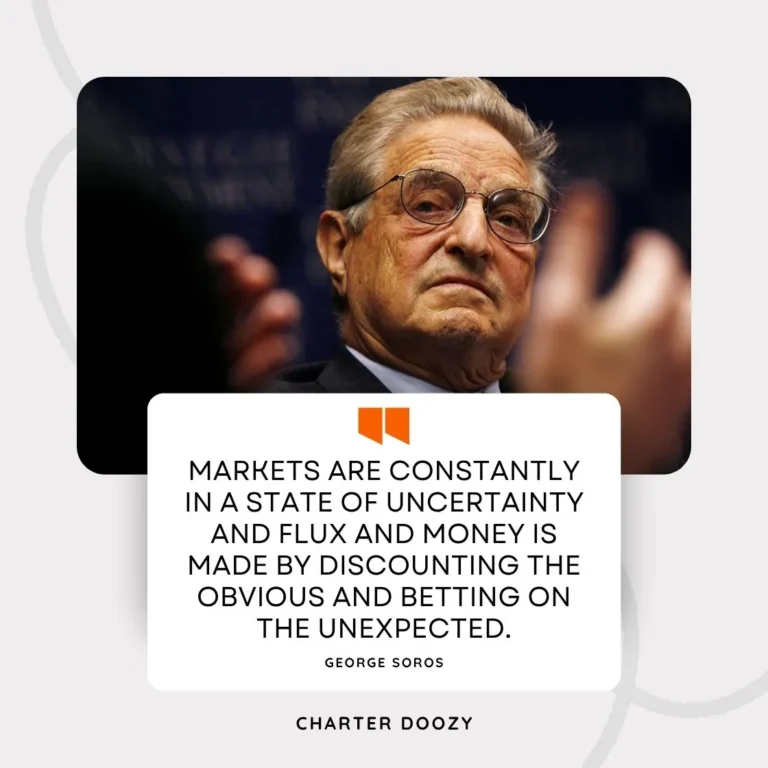
As Soros puts it:
“Markets are constantly in a state of uncertainty and flux and money is made by discounting the obvious and betting on the unexpected.”
Traditional economic models, including many taught in the CFA curriculum, rely on the idea that markets tend toward equilibrium. Soros challenges this, arguing that perceptions can become self-reinforcing, pushing prices far from equilibrium and even changing the fundamentals themselves.
Consider a housing boom. Rising prices fuel optimism, which increases credit availability, further pushing prices higher. Eventually, reality collides with expectations, triggering violent corrections. Soros’s entire career has been about identifying when these feedback loops are reaching unsustainable extremes—and placing large bets on the inevitable reversal.
Fallibility as a Competitive Edge
Equally important to Soros is the notion of fallibility. He constantly questions his own assumptions, insisting that investors must be humble enough to admit errors quickly. In his words:
“It’s not whether you’re right or wrong that’s important, but how much money you make when you’re right and how much you lose when you’re wrong.”
This principle underlies his risk management discipline. Soros might take massive positions, but he monitors them obsessively for signs that the thesis is invalid. If the facts change, he cuts losses without hesitation—a lesson every CFA candidate studying behavioral biases and loss aversion should internalize.
Legendary Trades and Stories
Breaking the Pound: Black Wednesday
No discussion of Soros is complete without recounting Black Wednesday, September 16, 1992.
Britain was part of the European Exchange Rate Mechanism (ERM), obligated to keep the pound within a specific band against the Deutsche Mark. Soros judged that Britain’s high interest rates were unsustainable and that the pound was overvalued. The UK economy was in recession, and the German Bundesbank refused to help support the pound.
Soros’s Quantum Fund reportedly built a short position worth over $10 billion against the pound. When the UK government tried to defend the currency by buying pounds and raising rates, Soros simply sold more. By the end of the day, Britain had withdrawn from the ERM and the pound devalued sharply, delivering Soros a profit exceeding $1 billion.
This trade illustrates several CFA curriculum themes—currency speculation, central bank policy credibility, and the impact of leveraged funds on market stability. It’s a live example of how fundamental analysis, combined with understanding policy dynamics and market psychology, can produce extraordinary results.
Riding the Yen and Other Macro Trades
Soros executed other high-profile trades. In the mid-1990s, he bet heavily against the Thai baht and other Asian currencies, anticipating the 1997 Asian Financial Crisis. He profited from shorting the Japanese yen during times of policy uncertainty.
Yet he also suffered setbacks. In 1987, Soros was caught long equities during the crash, and in the late 1990s, he misread Russia’s stability, suffering losses in Russian debt instruments. But true to his philosophy, he exited losing positions quickly, preserving capital for future opportunities.
Lessons for CFA Candidates and Professionals
The Limits of Models
Soros’s career is a challenge to rigid financial models. While the CFA curriculum teaches models like the Efficient Market Hypothesis (EMH) and Interest Rate Parity, Soros argues that markets often deviate significantly from theoretical predictions.
For CFA candidates, this underscores the importance of professional skepticism. Models are vital tools—but they are simplifications of reality. Investors must combine quantitative analysis with judgment about human behavior and policy risks.
Think in Probabilities, Not Certainties
Soros exemplifies thinking in terms of probabilities. He doesn’t seek certainty. Instead, he forms hypotheses about market imbalances and bets heavily when probabilities skew in his favor.
This aligns with risk management concepts in the CFA curriculum, including Value at Risk (VaR) and scenario analysis. Soros teaches that great investors are not those who are always right but those who recognize when odds shift and adjust exposure accordingly.
Behavioral Finance in Action
Soros’s reflexivity is essentially an application of behavioral finance—a major CFA topic. Price movements influence perceptions, and perceptions influence fundamentals. Recognizing these feedback loops can offer enormous edge.
For CFA candidates, this means studying market sentiment, understanding herd behavior, and being alert to signs of mania or panic.
The Power of Concentration and Courage
One of Soros’s defining characteristics is his willingness to act boldly. When he identifies a significant mispricing, he isn’t afraid to deploy enormous capital. Yet he couples this aggression with rapid recognition of error.
This balance between conviction and flexibility is a hallmark of great investing. For CFA professionals, it’s a lesson that size of position should match the strength of the thesis—and that pride should never block an exit.
Criticisms and Debates
Soros is a polarizing figure. Critics argue that his speculative attacks exacerbate financial instability, especially in fragile economies. Some governments blame him for contributing to currency crises.
Others debate whether his methods still work in today’s markets. Central banks have become far more active and transparent, sometimes countering speculators with vast balance sheets. The scale of global capital flows also makes crowded trades riskier than ever.
Moreover, Soros’s style requires an extraordinary depth of macroeconomic insight and a stomach for volatility that few investors possess. His approach may be impossible to replicate for most professionals managing client money under tight risk constraints.
Where to Learn More
For readers eager to delve deeper into Soros’s thinking:
- “The Alchemy of Finance” by George Soros: A challenging but essential read on reflexivity and macro speculation.
- “Soros on Soros: Staying Ahead of the Curve”: More accessible, blending autobiography with investment insights.
- Interviews with Soros on platforms like Bloomberg, FT, and various hedge fund conferences, which often explore his political views alongside financial commentary.
- Academic critiques of reflexivity theory, available in journals focused on financial economics and behavioral finance.
A Final Word: Embrace Complexity
George Soros is living proof that markets are not purely rational systems. They are shaped by human perceptions, politics, and feedback loops that can transform reality itself. For CFA candidates, he’s a reminder that while models and ratios are vital, markets often demand creativity, skepticism, and philosophical inquiry.
Soros’s life and career teach that great investors combine intellectual rigor with emotional resilience. They build frameworks for interpreting markets, but remain flexible enough to adapt when facts change.
As you study for the CFA, remember Soros’s central lesson:
Stay curious. Stay humble. And never forget that markets are ultimately a human creation—fallible, reflexive, and full of opportunity for those willing to look beyond the obvious.