Passing the CFA exams teaches you a great deal about hedge funds. You learn the textbook definitions, the categories of strategies, and the risk-return profiles that characterize these mysterious investment vehicles. The CFA curriculum does a solid job of summarizing hedge funds from 30,000 feet. It catalogs strategies, lists return characteristics, and defines terms like “absolute return.” That’s excellent preparation for passing exams.
Yet if your ambition is to become a portfolio manager, manage real capital, or move markets, you need to dig far deeper than any exam syllabus will take you. You need to understand how hedge fund managers think – not as a matter of theory, but of daily practice. You need to know what goes on inside the fund, behind the closed doors where investment legends are made… or sometimes destroyed.
It’s time to crack open the black box and peer inside. Let’s explore how some of the sharpest minds in finance design strategies, build systems, manage risk, and raise capital.
This isn’t the polished story you’ll find in textbooks.
It’s how it actually works in the trenches.
Beyond “Picking Stocks”
Popular culture has painted hedge fund managers as adrenaline-fueled gamblers. Hollywood would have you believe they’re prowling Bloomberg terminals in designer t-shirts, barking “Buy 500k!” while flinging stress balls at interns. Reality, however, is much less dramatic (and sometimes far more impressive).
At the surface, hedge funds certainly trade. But before any trading takes place, managers devote most of their mental energy to four critical pillars: designing strategies, building systems, managing risk, and raising capital. Only once these foundations are solid does actual trading begin.
Understanding these pillars is crucial. Because that’s how real hedge fund managers think.

Designing Strategies
A hedge fund’s strategy is not just an investment approach; it’s the firm’s entire identity. While the CFA curriculum might define strategy as the overarching method a fund uses to make money, that’s a superficial explanation.
In practice, a fund’s strategy becomes its brand, its reputation, and its reason for existence.
Funds live and die by their strategies.
They’re known for them in the marketplace. They attract investors based on them. And internally, managers and analysts obsess over refining and protecting them.
Consider the distinct reputations of well-known firms. KKR is synonymous with private equity deals involving operational overhauls. Jim Simons’ Renaissance Technologies is known for quantitative models that churn through vast oceans of data to extract tiny, repeatable edges. These identities are not marketing fluff. They’re the very heartbeat of the firms.
A strategy shapes three essential areas: how a fund raises capital, how it manages risk, and how it maintains discipline. Different strategies appeal to different investors. A distressed debt fund draws yield-hungry investors willing to tolerate illiquidity, while a long/short equity fund attracts institutions seeking equity exposure with downside protection.
The strategy also dictates the boundaries of risk-taking. A volatility arbitrage fund, for instance, has a risk profile utterly distinct from that of a global macro fund. Strategy becomes the fence that keeps managers from chasing shiny objects that could blow up the fund.
Before any manager clicks “buy” on a trading terminal, the fund might be analyzing default cycles, scrutinizing legal covenants, hunting for statistical anomalies in stock prices, or preparing to exploit short squeezes. The strategy underpins every single move.
HEDGE FUND STRATEGIES
EQUITY-BASED STRATEGIES
EVENT DRIVEN STRATEGIES


RELATIVE VALUE STRATEGIES

OPPORTUNISTIC STRATEGIES
OPPORTUNISTIC STRATEGIES
Building Systems
If you believe hedge fund managers succeed because they chase hot tips and live off whispers from rumor mills, think again. The best funds do precisely the opposite: they build robust systems.
Systems serve two critical purposes. They filter ideas before they ever become trades, and they help execute those trades without letting emotion creep in.
In the high-stakes world of hedge funds, where mistakes can be catastrophic, systems are the anchor that keeps the ship steady.
In a hedge fund, systems take many forms. Screening models help managers sift through vast numbers of potential trades to find those that fit their strategy. Pre-trade checklists ensure nothing is overlooked. Execution algorithms carry out orders efficiently, reducing market impact. Risk dashboards allow managers to track exposures in real time. Rules dictate when to enter or exit trades, how deals get approved, and how research pipelines operate. Even automated reporting systems keep investors informed with precision and consistency.
Ray Dalio’s Bridgewater Associates offers a striking example. Dalio famously turned his mental models into algorithms. This wasn’t merely about automation. It was about enforcing consistency and removing human bias from decision-making. Humans are naturally prone to chasing the latest shiny object. Systems enforce discipline and objectivity.
Even discretionary managers who rely on human judgment have systems—they just call them “process.” A credit portfolio manager, for example, might insist that no investment passes without signoff from the legal team. A macro manager might require detailed thesis documents before placing a single trade.
While systems alone can’t guarantee success, they are invaluable for preventing chaos. And in the world of hedge funds, chaos can quickly become an existential threat.
Managing Risk
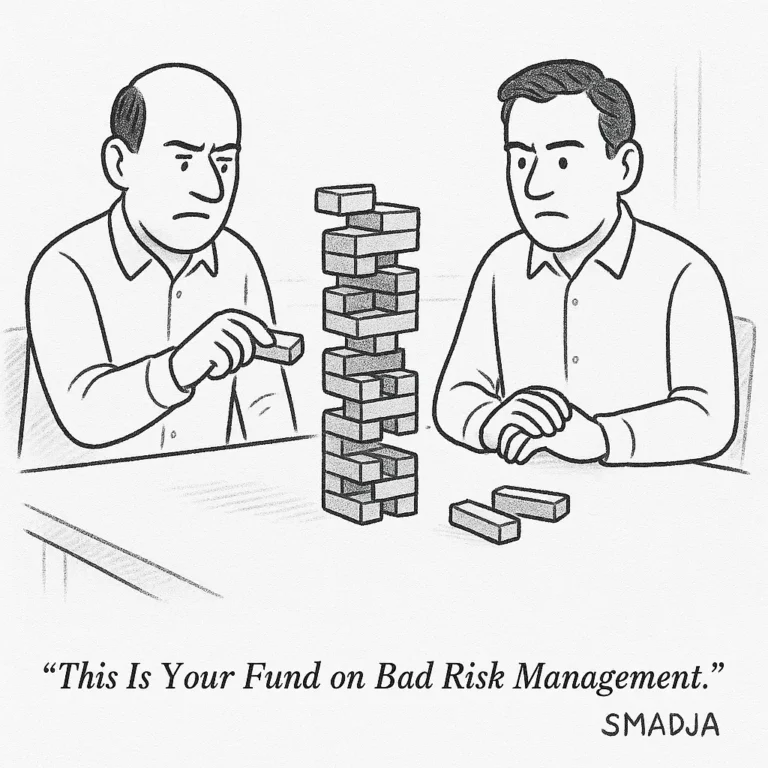
Few industries are as obsessed with risk management as hedge funds… and for good reason.
A mutual fund can underperform its benchmark for years and still survive. A hedge fund that suffers a 30% loss in a single quarter might lose its investors forever.
Consequently, hedge funds build elaborate risk frameworks. They employ Value-at-Risk models to estimate potential losses. They run stress tests to simulate worst-case scenarios. They categorize assets into liquidity buckets to ensure they can exit positions if markets seize up. Exposure limits, stop-loss rules, scenario analysis, and factor modeling all contribute to creating a buffer against disaster.
Risk management isn’t an afterthought. It’s as central to a hedge fund’s operations as picking stocks or executing trades.
The collapse of Long-Term Capital Management (LTCM) remains a cautionary tale for the industry. Despite a roster of brilliant PhDs and Nobel laureates, LTCM’s excessive leverage and interconnected trades led to catastrophic losses. The lesson endures: no amount of intellectual brilliance can save a fund from the perils of leverage gone bad.
Great hedge fund managers think about risk not merely as the chance of losing money but as the risk of blowing up the entire fund. They consider whether supposedly diversified trades might secretly be correlated. They ponder whether they can exit positions quickly if markets turn against them. They question whether any single trade is so large that it could sink the fund if it goes wrong. And crucially, they examine their own behavior to guard against the biggest risk of all: human emotion leading to reckless decisions.
Raising Capital
Running a hedge fund is more than just managing money.
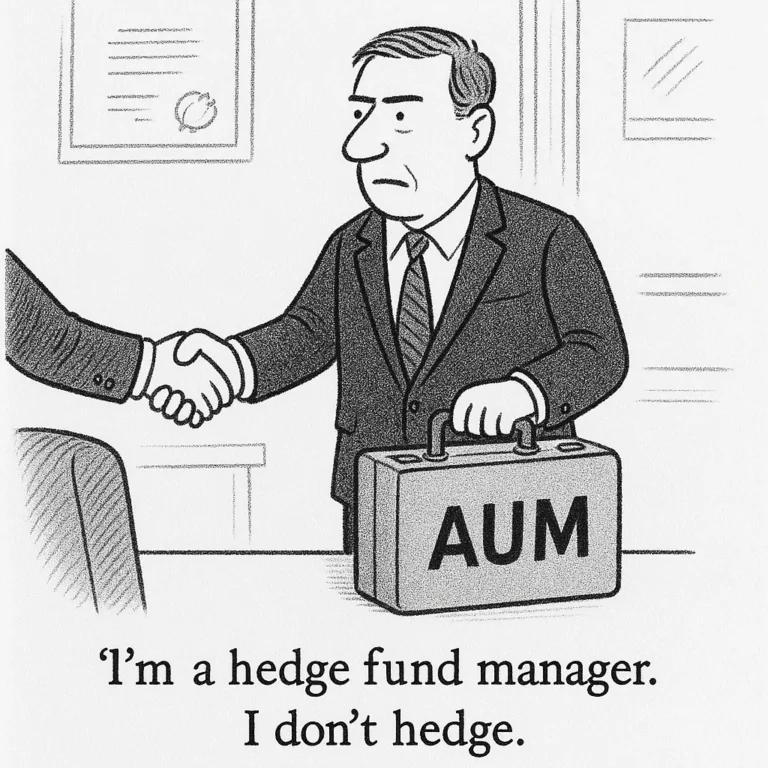
It’s a business… and that business depends on one critical metric: Assets Under Management (AUM). A hedge fund earns its income through management fees, often around 2% of AUM annually, and performance fees, typically 20% of profits. Low AUM means low revenue, which threatens the fund’s survival.
But raising AUM is no simple task. Institutional investors demand rigorous scrutiny. They ask probing questions about a fund’s strategy, its edge, its risk management practices, team structure, and how much of the managers’ own money is invested alongside clients. In other words, they want proof that the fund can deliver returns in a repeatable, disciplined, and trustworthy manner.
As a result, hedge fund managers spend a significant portion of their time on marketing. They prepare pitch decks. They answer exhaustive due diligence questionnaires. They write investor update letters. They attend conferences, deliver presentations, and participate in roadshows.
Even marketing feeds back into strategy. Different investors have different appetites for risk and different desired exposures. A fund’s identity (its strategy, style, and reputation) becomes critical for attracting the right capital. No strategy means no pitch. No pitch means no AUM. And without AUM, there is no hedge fund.

Why It Matters for CFA Candidates
If you’re a CFA candidate, all of this should ignite your curiosity and excitement. Studying hedge funds in the CFA curriculum isn’t just about memorizing definitions or learning about Sharpe ratios and performance fees. It’s about beginning to think like a fund manager.
Yes, the CFA program teaches you essential elements… hedge fund strategies, return distributions, benchmark complications, and the mechanics of fee structures.
But it rarely asks the deeper, practical questions: How do you decide which trades truly fit your strategy? How do you construct a scalable research pipeline? How do you guard against cognitive bias in your trade selection? How do you prevent risk from spiraling out of control? How do you persuade skeptical investors to commit capital to your fund?
Those are the questions that separate hedge fund tourists from genuine professionals. The good news is that the CFA curriculum provides the raw material. It’s up to you to dig deeper, connect the dots, and cultivate the mindset that turns theory into practice.
Interested in Learning About Other Hedge Fund Strategies?
The Final Thought
Inside a hedge fund, picking trades is merely the final act. The crucial work happens beforehand. First, you pick your identity through strategy. Then you systematize your thinking to enforce discipline and consistency. You build robust safeguards to protect your downside. And finally, you convince investors to place their trust (and their money) in your hands.
That’s the real world of hedge funds. That’s the mindset you’ll need if your goal is to move from passing CFA exams to actually running money. Because in the end, it’s not just about finding trades. It’s about becoming the kind of professional who can navigate markets, manage risk, and build a lasting business in one of the toughest arenas in finance.
Welcome to the journey. This way to alpha.